• Is Coffee Good for Mental Health? Here’s What I Know From My Research

    I’ve been trying to save money lately. Between car repairs, rising gas prices, taxes, grocery trips, and unjust wars, I’ve been a little strapped for cash. Alas, you don’t need to read my financial lamentations because I’m certain we all have similar stories right now. Regardless, one thing I cannot forget to forego is my coffee. It’s not merely some social obligation or the company of a good friend that keeps me peppy; it’s what keeps me from descending down that dank, dark rabbit hole of despair and dysfunction. Every once in a while though, I forget.

    Whether it’s me saving money or thinking going latte-less will suddenly transform me into the next Top Model, I occasionally cut my coffee consumption way down and opt for a green tea. I love tea. I think tea is a wonderful comfort except on the days when I have gone without coffee for far too long.

    For those wondering, I usually only drink one or two cups a day unless I’m at a diner where the waitress keeps refilling my cup. In that case, I’m buzzing out the door, tap-dancing to the rhythm of “Flight of the Bumblebee.”

    • 1 day without coffee: I’m fine. In fact, it’s my Sunday ritual. I watch Youtube videos or old episodes of Big Bang Theory and Gilmore Girls all day while I tend to creative endeavors I was too tired for the previous week.
    • 2 days without coffee: I feel like something is a little off and ask the cat if she has any idea what my problem is. The cat always thinks I’m weird, so this isn’t abnormal. Even when I’m hugging her and weeping into her fur before bed, she regards this as normal behavior since I cried for the first six months we knew each other. I remember my coffee maker being broken at the time.
    • 3 days without coffee: I’ve declined from coherent ramblings to swearing like a sailor and putting Romani curses on everyone who dares make eye contact with me, except for the sweet elderly lady at Trader Joe’s who insisted I go in front of her as I clutched my bag of Arabica dark roast like a teddy bear. I am also responding to emails in ways that remind me how coffee keeps me nice. “Per my last email…

    Some will say my experiences are symptomatic of acute withdrawal from an addictive substance and may even liken it to other drugs. This was the observed and published consensus in the dawn of the 2000s. On February 7, 2014, a John Hopkins University article was published by Brandon Ambrose titled, Caffeine Use Disorder: It’s Real and Warrants More Attention, while less than a month earlier, on January 14, a contrary article was written by the same researchers, confirming caffeine actually helped memory.

    In Ambrose’s article, researchers said the problematic results of caffeine use included cardiovascular problems and prenatal complications. Back then, Laura Juliano, an American university psychologist stated, “While many people can consume caffeine without harm, for some it produces negative effects, physical dependence, interferes with daily functioning, and can be difficult to give up, which are signs of problematic use.”

    Now, here we are, twelve years later, and the tables have turned. An August 2025 article published in Nutrients Journal stated that current research shows that three-to-five cups of coffee a day actually has long term health benefits, including lower risk of cardiovascular disease, diabetes, stroke, and several types of cancer. Regarding the longstanding taboo of drinking coffee while pregnant, that has also been reversed. According to Nutrients Journal, mothers-to-be are safe to consume caffeine, limiting their consumption to a reasonable 200 mg.

    I am going on record right now to say I am not a medical professional or researcher, nor do I claim any special knowledge of anything. I am only quoting their findings. Everything I know about coffee has been learned from my own experience. That experience where I am resurrected from days as a zombie to fully-focused livelihood within the first half cup of coffee. It’s not a result of feeling more awake or on the move. For me, it’s mental stability. It may be the serotonin hit. It may even be more of a gut-to-brain axis influence.

    Even more recently, the April 2026 edition of Journal of Affective Disorders published an article researching the effects of coffee on mental health and who benefits the most. Studies concluded that moderate coffee intake (due in part to the antioxidants and other beneficial compounds) helped lower depression risks, but higher caffeine intake could cause more distress in some individuals. The one thing that remains consistent in coffee research is the inconsistency of its results.

    Why? In my unaccredited opinion, each of us are made differently; different metabolisms, different dietary needs, different hormone fluctuations, different tolerances. Throughout our lives, it is our responsibility to learn and understand ourselves, our bodies, minds, and their needs. In the same way that cheese is my must-have happiness food, coffee is my must-have mood stabilizer. It also helps that coffee comes in cute cups and sometimes wears sweaters.

    If you enjoyed this article, I’d love for you to subscribe so you don’t miss a moment with Coffee Adventures/Cozy Coffee Notes. If you want to support Traveling Coffee Girl, even a small cup of coffee goes a long way.

  • Coming Soon: Refill Your Mug

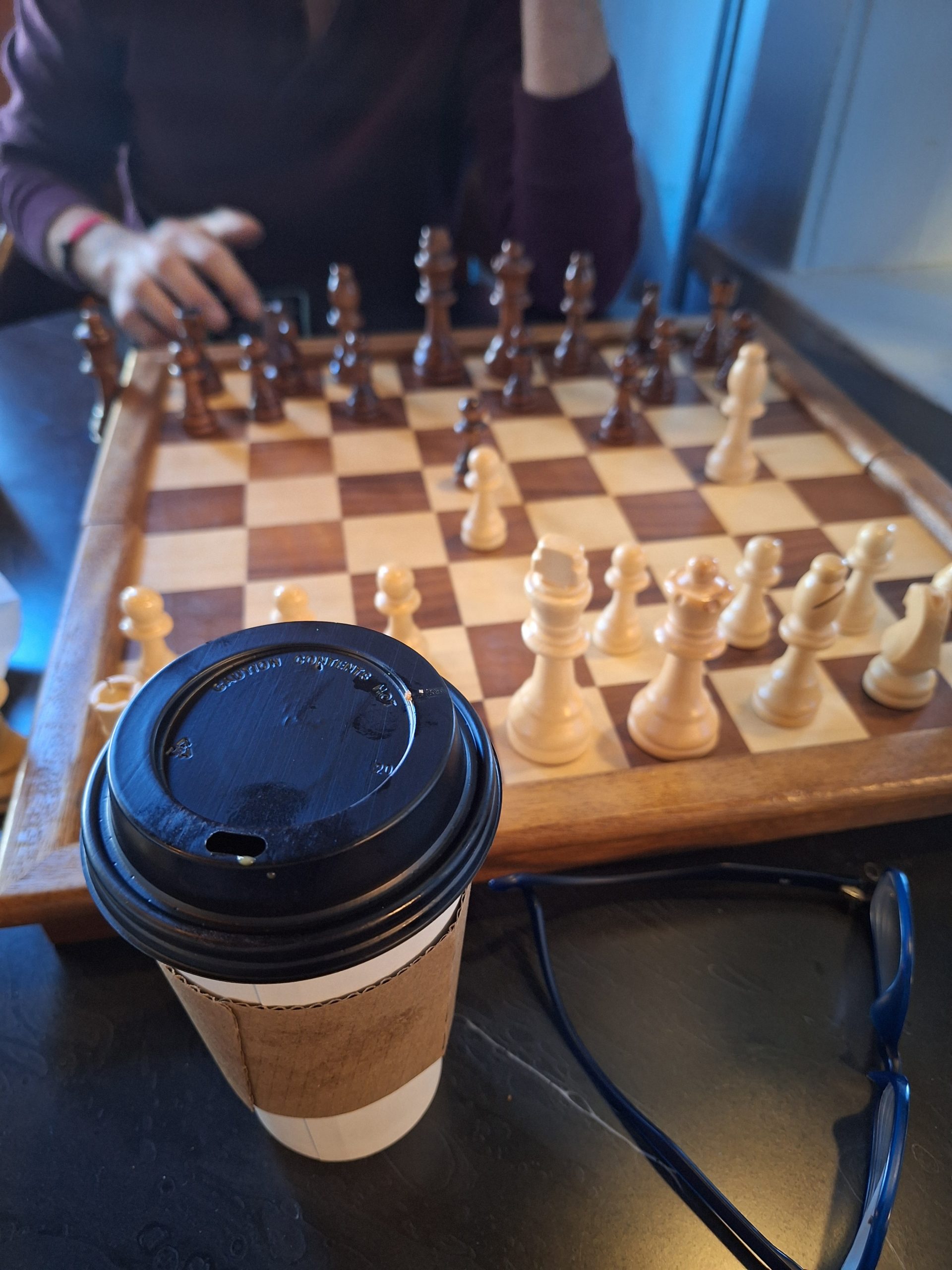
    The idea for a podcast was mentioned simply enough around the time that Nate and I first brainstormed writing stories about coffee, travel, and life for Traveling Coffee Girl. Long before he regaled readers with how I accosted him to tell his shark story, we met up for coffee and chess to figure out the next idea.

    Well, if I’m honest, I talked.

    He played chess.

    I overthought every move while he made up Tarantino-esque stories about the Queen on a serial rampage. He chided me, “You’re not being aggressive enough.”

    I wondered if he was talking about the way I played chess, or if he was making a general critique on the manner with which I conducted my life. In my overthinking, projective mindset, I determined it was both, so I heaved a sigh, refrained from rolling my eyes, and stopped obsessing about my next move. I played another game and drank another coffee. After another long-suffering defeat, Nate pointed something out: when I relaxed, I played better. I even almost  won.

    Almost.

    I have always been a story collector. I don’t believe in such a thing as “boring.” Everyone has a life-changing story to tell.

    I thought, what better than to combine my love of stories and the ease I meet people with a coffee in my hand, while also getting a little more aggressive in developing my content in the early stages?

    My idea: Refill Your Mug;

    A podcast where artists, creatives, and creators get comfy with a cup of whatever makes them coziest, and we talk like two friends at a coffee shop. Discussing everything from their newest release and what inspires their work to their thoughts on the world and how they would make it better.

    Get comfy, girl. We’re recording.

    If you’d like to help support our upcoming Refill Your Mug podcast or subscribe to a monthly membership to keep our adventures going, be sure to Buy Me a Coffee and tell your friends.

  • This week I am going off topic again. The reason is because I had the honor of speaking to the thoughtful, intelligent, and empathetic law students in Dale Baich’s class at the ASU Sandra Day O’ Connor School of Law about the USSC Ring v. AZ case. Speaking about the case and about my dad, John Magoch, was part speech and part long-awaited eulogy. It’s the main thing I have been thinking about all week, so I recorded the talk and consider this as a companion and to my I Never Wanted to Get Political article. Even if only five people hear this, I know it’s time I said it all.
    The Ring v. AZ case reminds us that a murder doesn’t end with the victim. Its aftermath touches and kills a part of everyone who is affected.. It’s a club those of us who are left behind never wanted to be a part of, and doesn’t necessarily define our whole lives, but it isn’t something that we will ever fully “get over”. (Yes, people have told me this. I should just get over this.)


    This talk was another step in the long-term healing process that may take a lifetime. Anyone who knows me, this is why I always say, “I Love You”, even if it’s a little uncomfortable.